Speech Therapy Funding in Australia: Medicare, NDIS and Private Health - Children
Stay up to date with the latest speech pathology tips and trends
A simple guide to Medicare rebates, NDIS support and private health claims.
When families first start exploring speech therapy, one of the most common questions is about funding options that may help pay for therapy.
Speech therapy services in Australia can be funded in different ways depending on a child’s needs, their age and their communication challenges.
Below is an overview of the most common funding options available to families when accessing speech therapy services.
Medicare Support for Speech Therapy
Medicare may contribute to the cost of speech pathology services.
These rebates are accessed by speaking to your GP or paediatrician and are designed to support people who require allied health care as part of their broader health management.
Medicare Chronic Disease/ Management Plan/ Chronic Condition Management Plan:
Under this plan, a GP can coordinate care for patients who have a medical condition that has lasted, or is expected to last, six months or longer. As part of that care plan, the GP may refer the patient to allied health professionals, including speech pathologists
Medicare allows up to five allied health services per calendar year under this pathway. These sessions can be used for speech pathology or the GP may recommend that the sessions are shared across other allied health services such as occupational therapy or physiotherapy.
Funding under the Chronic Condition Management Plan can be renewed each calendar year.
It’s important for families to know that Medicare rebates are intended to contribute toward the cost of care, rather than covering the full cost of therapy.
Additional Medicare Support: M10 items
For more information check out our quick guide to M10
This extension of the M10 program under Medicare supports children and young people under the age of 25 who require assessment or treatment related to specific disabilities or neurodevelopmental conditions – including autism, and a broad range of syndromes that impact on children’s overall development. .
Clients may access:
- Up to eight allied health assessment sessions across a person’s lifetime
- Up to twenty treatment sessions across a person’s lifetime
(Sessions limits apply to all allied health professionals)
Recent updates to the Medicare Benefits Schedule now mean that children who are diagnosed, or are suspected of stuttering, speech sound disorders or cleft lip or palate can receive a rebate for their therapy sessions.
Access to the Medicare M10 benefit items requires a referral from a GP, specialist or consultant physician (e.g. paediatrician). A check-in with the referring practitioner may be required after 4 assessments, and a new referral is required after the first 10 therapy sessions.
Medicare M10 funding can be used in addition to Chronic Care Management Plans.
Speech Therapy and the NDIS
The NDIS provides funding for supports that help people with disability participate in everyday life and build independence. For children with communication needs, speech therapy may be included where it supports the goals outlined in their NDIS plan.
NDIS plans are tailored to the individual, so the amount of therapy funded can vary depending on a child’s circumstances and goals.
For families who are new to the NDIS, navigating the system can sometimes feel overwhelming. Our team at NSST work continuously to keep informed of NDIS changes and updates. We are here to support you on this journey and work alongside you to advocate for your child’s NDIS funding needs.
Private Health Insurance
Some families claim speech therapy services through their private health insurance extras cover.
When speech pathology is included in a policy, families may receive a rebate toward the cost of each session. The amount that can be claimed varies depending on the health fund and level of cover.
Because each policy is different, it’s helpful to contact the health fund directly to check:
- whether speech pathology is included
- how much can be claimed per session
- whether annual limits apply.
Finding the Right Funding Options for Your Child
Every child and every family’s situation is unique. Funding options depend on factors such as a child’s needs, their communication challenges and their age.
If you are unsure where to begin, talk to our team at North Shore Speech Therapy about what options are available. You can also speak to your GP if you would like to access funding for speech therapy sessions through Medicare. We will work closely with you so you understand how different funding supports can help you access speech therapy sessions and maximise your child’s communication development.
At North Shore Speech Therapy, we regularly help families navigate these questions so you can focus on what matters most — supporting your child’s communication and confidence.
Summary Table
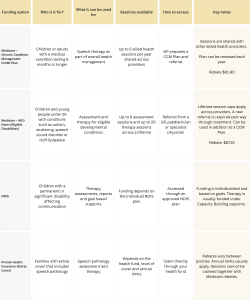
*Pricing and information current as of 16th March 2026
*This is a summary table only – funding options may vary depending on personal situation and should be individually investigated.
Contact form
Search
Categories
Recent Posts
What Families Need to Know
Posted 01 May 2026

Neurodiverse Family-Friendly Activities in Sydney: 2026 Guide
Posted 27 Apr 2026

7 Things Parents of Kids With Apraxia Want You To Know
Posted 16 Apr 2026
Newsletter
Keep up to date with the latest insights on speech therapy and language skills development from the team at North Shore Speech Therapy.
subscribe form